Choosing an extension by the load’s total length alone can leave too much unsupported material beyond the fork tips or place the load centre outside the truck’s safe operating range. By the end, you will know how to select a practical size, verify fork and pocket compatibility, calculate the capacity impact, and check the attachment before lifting.
Key takeaways
- Support the load section, not its full length, with the extension.
- Measure fork width, thickness and length before checking extension pockets.
- Recalculate capacity when the extension shifts the load centre forward.
- Inspect both extensions, retaining devices and load contact before every lift.
Match extension length and size to the load you actually support
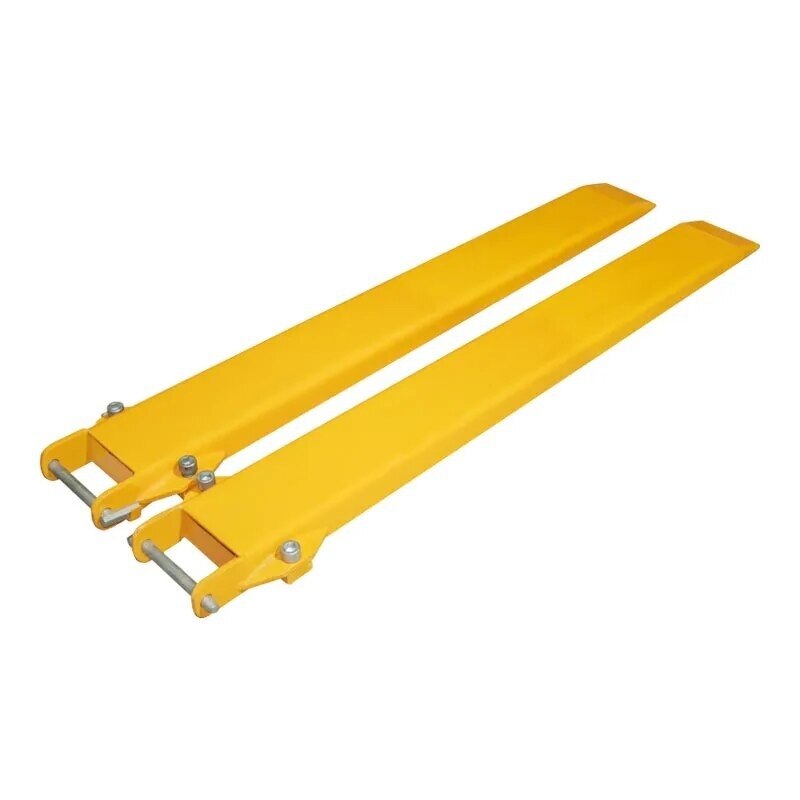
Choose the extension from the load section that needs fork support, not the load’s full overall length. The extension must provide contact under the supported area without pushing the load centre too far forward. Common forklift fork extension sizes include:
| Length | Suitable application | Check before use |
|---|---|---|
| 1,200 mm | Short pallet or limited additional support | Base fork and usable contact length |
| 1,500 mm | Moderate support for compact, stable loads | Pocket fit and load distribution |
| 1,800 mm | Longer, well-bundled loads | Truck capacity and support points |
| 2,100 mm | Longer bundles with adequate base-fork support | Manufacturer approval and load centre |
| 2,400 mm | Exceptional reach requirement | Written approval and engineered review |
Treat each listed length as the extension’s outside dimension. Pocket depth and the retaining heel reduce the usable load-support length, so subtract both, plus any unsupported tip allowance, before deciding whether the load has enough contact.
Under OSHA 1910.178(e)(4), an extension cannot exceed 1.5 times the supporting fork’s length. A 1,200 mm base fork therefore has an 1,800 mm dimensional ceiling; that ceiling does not authorise lifting at the truck’s full rated capacity. Confirm the extension rating, revised load centre and truck approval.
Forklift fork extensions in Pune, including forklift fork extensions for long loads, suit stable, evenly distributed loads. Flexible sheets, loose pipes, coils and shifting loads need a different handling method or engineered attachment.
Measure the host forks and confirm the pocket will fit
Measure actual fork geometry, not forklift tonnage, before ordering. Record each fork’s length from heel to tip, section width across the top and thickness from the top surface to the underside. Photograph the heel profile and measure the usable space behind it.
Forklift fork extension sizes must match the individual fork, because two trucks described as “3-ton” can have different fork sections and load-centre ratings. Ask the supplier for these details:
- Internal pocket width and height, not just outside dimensions
- The extension distance between its retaining lip, strap, pin or heel lock and the pocket end
- Marked compatible fork dimensions, extension self-weight, material specification and rated load
- Written compatibility confirmation for your specific truck and fork pair
Open-bottom and full-pocket designs do not provide the same enclosure:
| Design | Pocket arrangement | Check before ordering |
|---|---|---|
| Open-bottom | Underside remains partly exposed | Confirm the fork seats without excessive vertical play |
| Full-pocket | Surrounds more of the fork section | Confirm width and height allow full insertion without binding |
The fork must slide fully into the pocket, and the retaining component must fit completely behind the fork heel. Excessive side or vertical clearance allows movement during braking or mast tilt; a pocket that is too tight can prevent seating and damage the fork or extension.
Give a forklift fork extension supplier in Pune your measured dimensions and heel photographs, then obtain written confirmation rather than relying on “suitable for 3-ton forklifts.”
Recalculate capacity when the extension moves the load centre forward
A fork extension does not increase the forklift’s rated capacity; it moves the effective load centre forward, reducing allowable capacity and longitudinal stability. The capacity plate and manufacturer’s load chart govern the lift, while the extension’s rating is only one limit.
As a screening example, a truck rated for 2,500 kg at a 500 mm load centre gives an inverse-centre estimate of about 1,667 kg at 750 mm. Use that figure to understand the penalty, not to authorise a lift. The manufacturer’s chart also accounts for mast geometry, attachment weight and residual capacity.
Assess the combined centre of gravity of the load and extension, including any load overhang beyond the tips. Forward-shifted mass narrows the stability margin inside the forklift’s stability triangle and increases steering effort, braking distance and forward tip-over risk.
Forklift fork extensions for long loads demand low travel height, clear visibility, controlled turns and smooth braking.
Before lifting, confirm:
- The extension rating exceeds the intended load.
- The truck’s revised chart capacity exceeds the actual load at its new load centre.
- The load is centred and supported across both extensions, with no unstable overhang.
- A sideshifter, clamp, rotator or other forklift attachments in Pune has its weight and load-centre change included in a separate residual-capacity assessment.
- The capacity marking is revised when the manufacturer or authorised assessor requires it.
Repeated long-load work, high overhang and uneven bundles justify longer rated forks or an engineered attachment rather than continuous reliance on extensions.
Install, secure and inspect both extensions before every lift
Before every lift, fit and inspect both extensions with the forklift stationary on level ground, forks lowered, parking brake applied and people clear.
1. Slide each extension fully over its supporting fork until its rear contacts the fork heel. Engage the retaining lip, heel strap, retaining pin or heel lock completely around the back of the fork. Never lift with an extension that is merely resting on the fork.
2. If using a pair, compare the front projection and rear seating of both extensions. Make sure they project evenly; unequal projection can shift the load sideways and overload one extension.
3. Check that each retaining pin or lock cannot fall out, the pocket is not spread or bent, and the extension sits level without excessive side movement. Confirm that the load is stable, centred across both extensions and supported well back from the tips.
4. Inspect the welds for cracks, retaining holes for elongation, heel straps for damage, and steel surfaces for sharp gouges, twists or permanent deformation. Remove defective equipment from service; repainting does not repair a crack or distortion.
5. Lift the load a few centimetres, stop and check that neither extension has moved forward. If you use forklift fork extensions in Pune, apply the same check in every operating area, not only during installation.
6. Remove the extensions only after lowering the load and forks fully. Store them where pockets, retaining pins and heel components cannot be struck or damaged.
Choose a Pune supplier that can document the complete combination
Before placing an order, give a forklift fork extension supplier in Pune the host fork length, width, thickness and heel profile, plus the truck model, rated capacity, existing load-centre rating, and the load’s actual dimensions and mass.
Ask for these documents and measurements:
- Marked extension capacity, compatible fork dimensions and usable support length
- Extension self-weight and steel or material specification
- Retaining lip, strap, pin or heel-lock details
- Inspection instructions covering cracks, deformation, pocket wear and retaining parts
- Written confirmation that the pocket fits your specific fork and that the combination was checked against the truck manufacturer’s load chart
Use the supplier’s recommendation according to the work pattern:
| Option | Suitable use | Decision warning |
|---|---|---|
| Occasional long-load handling | Stable, evenly distributed loads | Recheck seating and capacity before each lift |
| Repeated long-load handling | Frequent travel or high handling frequency | Specify longer rated forks or an engineered attachment |
| High overhang or uneven bundles | Loads with shifting support or centre of gravity | Do not approve a generic extension rating |
Ask whether the recommendation covers occasional handling or repeated long-load work. Extensions add an interface that must be retained, inspected and capacity-assessed; longer rated forks remove that extra point of failure. This matters when comparing forklift attachments in Pune, not just forklift fork extensions in Pune.
VIMALNX EQUIPMENTS PVT LTD is useful at this decision point if the discussion identifies usable support length, retaining arrangement and the revised capacity basis rather than stopping at a catalogue quotation. Reject the order if those details are missing.
Related product
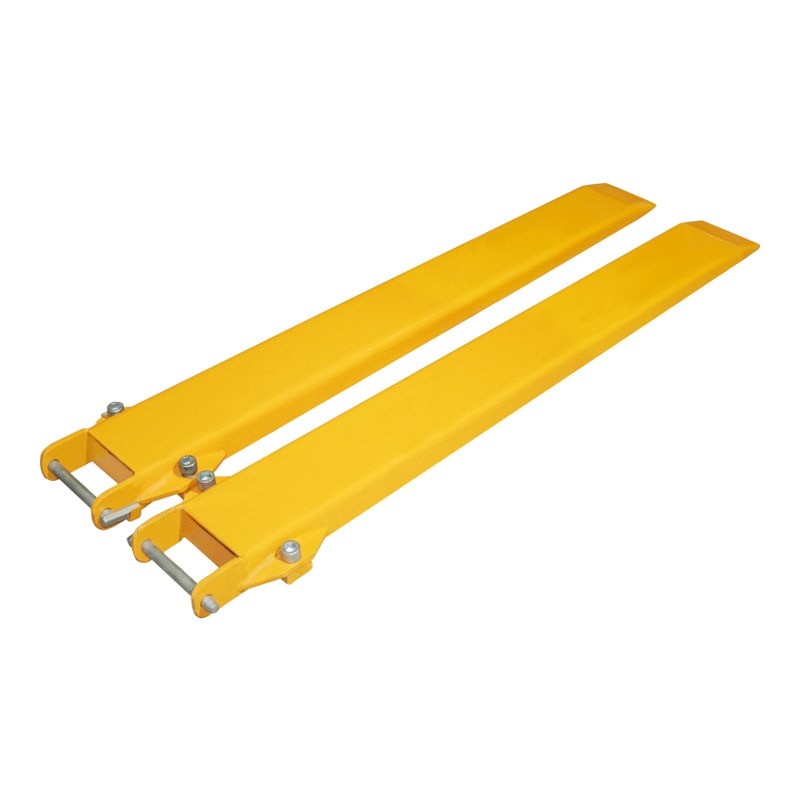 | Spares ₹10000 Extend Your Forklift’s Reach for Longer & Wider Loads The VimalNX Forklift Fork Extensions are heavy-duty attachments designed to increase the length... View product → |
Frequently asked questions
How do I choose the right forklift fork extension size?
Choose an extension that supports the load section needing fork contact without moving the load centre unnecessarily far forward. Compare the extension length and size with the host fork and the load dimensions.
How do I know whether an extension will fit my forklift forks?
Measure each host fork’s width, thickness and length, then compare those measurements with the extension pocket dimensions. Confirm that the pocket fully accommodates the fork before use.
Why must I recalculate forklift capacity with fork extensions?
An extension moves the supported load farther forward, increasing the load moment. Recheck the forklift rating at the new load centre using the manufacturer’s capacity information.
What should I inspect before using forklift fork extensions?
Inspect both extensions for cracks, bending, damaged pockets and loose retaining devices. Confirm that each extension is seated fully on the fork and that the load has stable contact before lifting.
What should a forklift fork extension supplier in Pune document?
Ask for documented extension dimensions, pocket fit, rated use, retaining arrangements and the forklift-load combination reviewed for your application.
Keywords