

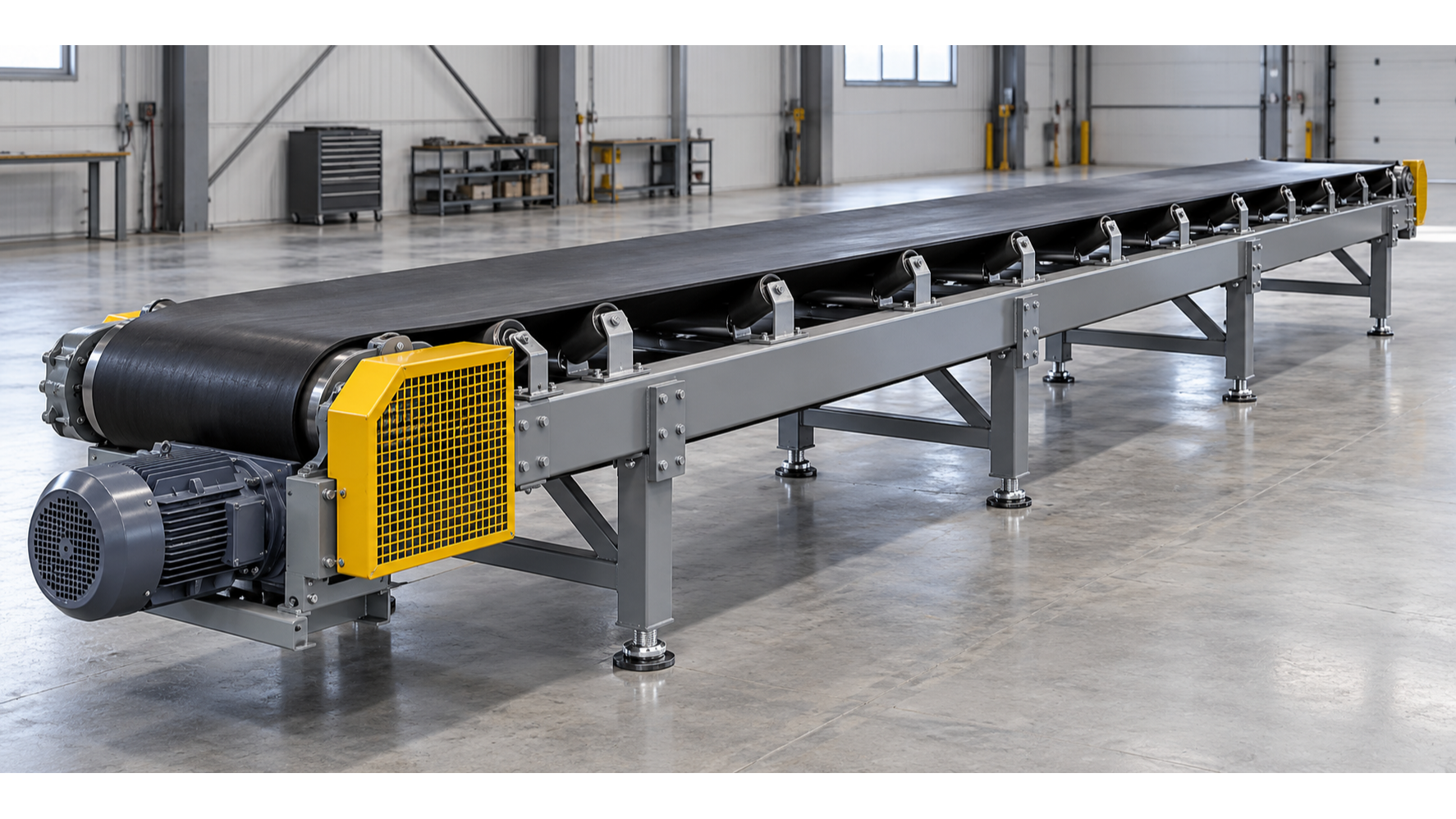
A belt conveyor can appear to be a straightforward piece of equipment: a moving belt carries material from one point to another. In an industrial facility, however, conveyor performance depends on numerous application details including product characteristics, required throughput, transfer points, layout, speed, environment, and integration with upstream and downstream processes.
Selecting a Belt Conveyor Manufacturer should therefore begin with process data rather than a request for a standard conveyor length.
Define the Material First
The product being transported determines many conveyor requirements.
A conveyor handling sealed cartons has different operating conditions from one transporting loose components, bags, packaged food, industrial parts, or irregular products.
Provide the manufacturer with information about:
- Product dimensions
- Individual and total load
- Product shape
- Packaging
- Surface characteristics
- Required orientation
- Temperature or environmental conditions
- Potential contamination concerns where relevant
If several products will use the same conveyor, identify the smallest, largest, lightest, and heaviest items.
Calculate Required Throughput
Conveyor capacity should correspond with the actual production or warehouse process.
Determine how many products need to move during a defined period and whether flow is continuous or intermittent.
A conveyor that moves products faster than the downstream process can accept may simply create accumulation. One that is too slow can restrict output from upstream equipment.
The objective is synchronized material flow.
Examine Transfer Points Carefully
Many conveyor problems occur where products enter, leave, or transfer between conveyors.
Height differences, gaps, product dimensions, orientation, and speed can affect transfer performance.
When planning a conveyor line, identify every transfer rather than evaluating individual conveyor sections in isolation.
This is especially important for smaller products that may be more sensitive to gaps or changes in direction.
Layout Should Follow the Process
Before requesting a quotation, create a simple layout showing the starting point, destination, available space, required conveyor length, operating height, nearby machinery, and movement routes.
For factories in Pune, existing layouts may contain columns, utilities, workstations, and equipment that constrain the available conveyor path.
Site-specific measurements can prevent expensive changes during installation.
Think About Integration
A belt conveyor rarely operates completely independently.
It may receive products from a machine, inspection station, packing area, worker, another conveyor, or storage system. At the discharge end, another operation takes over.
Controls and mechanical interfaces should therefore be discussed as part of the complete process.
VIMALNX EQUIPMENTS PVT LTD works with industrial material handling requirements in Pune, Maharashtra, where conveyor systems may need to integrate with production, packaging, warehousing, and dispatch operations.
Compare Manufacturers Beyond Price
Procurement teams can compare proposals using several criteria:
- Understanding of product characteristics
- Conveyor dimensions and capacity
- Belt selection for the application
- Drive arrangement
- Speed requirements
- Supporting structure
- Controls and integration
- Maintenance accessibility
- Installation requirements
- Technical documentation
If quotations differ significantly, compare the underlying technical scope before deciding that one option is simply more expensive.
Consider Total Operational Value
The lowest initial price does not always represent the lowest operating cost.
A conveyor that reduces repeated manual transfers, supports consistent product movement, and integrates effectively with adjacent processes may deliver value throughout daily operations.
Maintenance requirements and access to wear components should also form part of the evaluation.
Know When You Are Ready for a Detailed Proposal
A company is ready to request a technical conveyor proposal when it can define the product, load, throughput, start and end points, dimensions, operating environment, and integration requirements.
Providing photographs, facility layouts, process diagrams, and product samples or dimensions can improve specification accuracy.
For Pune manufacturers and warehouse operators, belt conveyor selection is ultimately a process-engineering decision. When product behavior, throughput, layout, transfers, and maintenance are considered together, the conveyor can become a reliable link between operations rather than simply another piece of equipment on the factory floor.