
Increasing production or warehouse capacity can create an unexpected problem: materials need to move between different elevations, but conventional inclined conveyors require more floor space than the facility can comfortably provide.
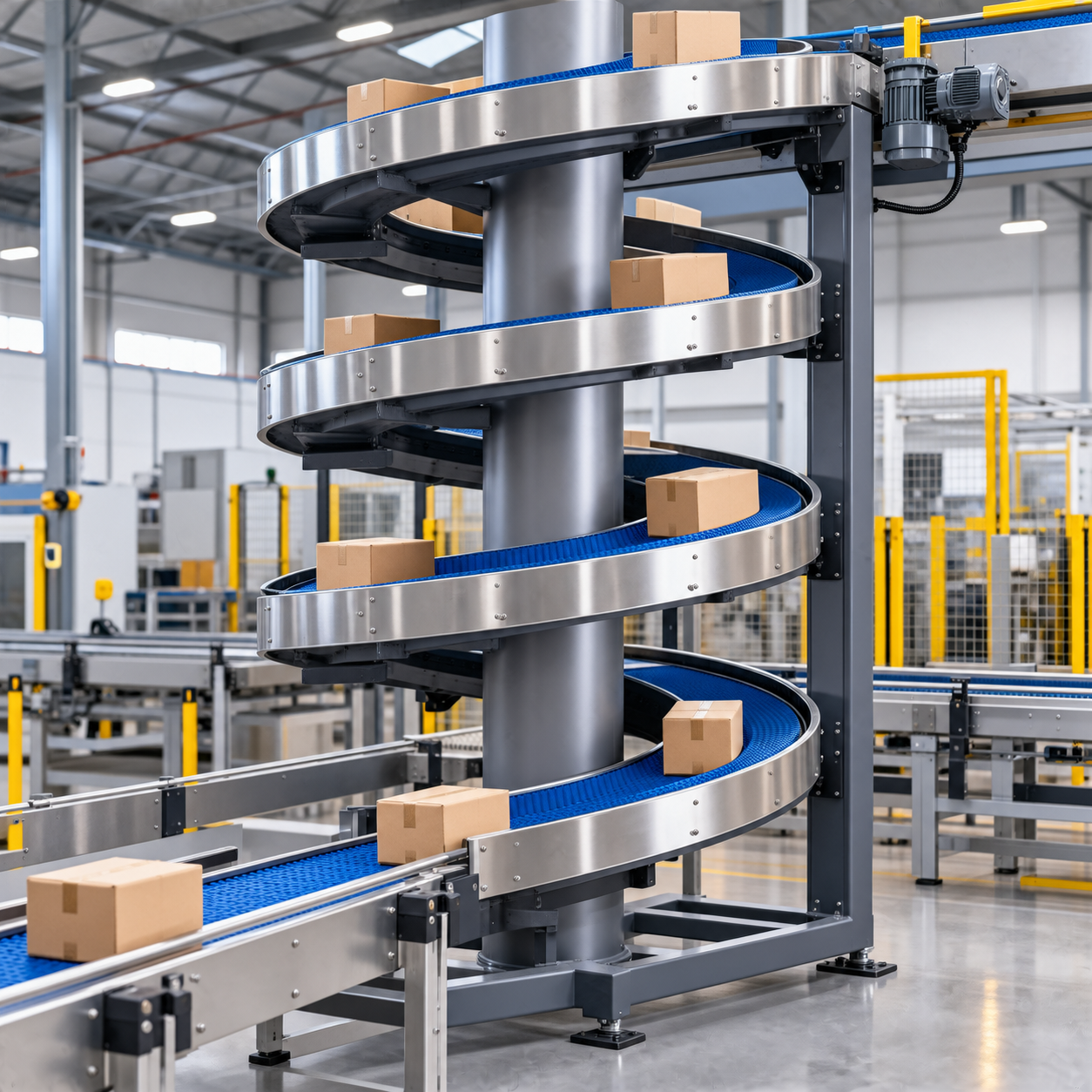
A spiral conveyor offers a way to achieve continuous vertical product movement within a comparatively compact footprint. Selecting the right Spiral Conveyor Manufacturer, however, requires careful assessment of product dimensions, throughput, elevation, available space, transfer conditions, and system integration.
When Is a Spiral Conveyor Worth Considering?
A spiral configuration may be appropriate where products need to move continuously between levels and floor space is limited.
Potential applications can include movement between:
- Production levels
- Packing and dispatch areas
- Mezzanine floors
- Warehouse levels
- Sorting systems
- Conveyor networks
- Processing and packaging sections
Whether a spiral conveyor is suitable depends on the product and process rather than elevation alone.
Product Stability Is Important
Products need to travel reliably along the conveyor path.
Cartons, totes, packaged goods, and other loads can have different stability characteristics depending on dimensions, weight distribution, base surface, and packaging.
Industrial buyers should provide actual product information rather than only specifying maximum weight.
If the system needs to handle multiple product sizes, the full range should be evaluated.
Calculate the Elevation Requirement
Measure the vertical distance between the conveyor's infeed and discharge levels.
Then consider the available floor footprint and the location of surrounding equipment or structures.
A spiral conveyor may reduce the horizontal space needed compared with a long incline, but it still needs to integrate properly with the building and adjoining conveyor sections.
Throughput Should Match the Whole Line
The conveyor should not become a bottleneck.
Procurement teams need to understand the required product rate and how items enter and exit the spiral. Upstream and downstream equipment should be considered when determining operating speed and accumulation requirements.
If the next process cannot accept products at the required rate, simply increasing conveyor speed will not solve the broader flow problem.
Compare Spiral and Inclined Conveyor Options
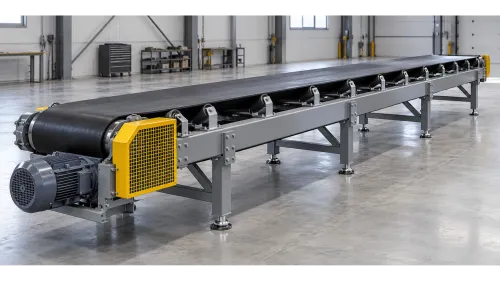
An inclined belt conveyor can be practical where sufficient horizontal space is available and the product is suitable for the incline.
A spiral conveyor becomes particularly interesting when vertical movement is required within a constrained footprint or when the facility needs a compact connection between levels.
The comparison should consider:
- Available floor space
- Required elevation
- Product characteristics
- Throughput
- Transfer points
- Maintenance access
- Integration complexity
- Overall project economics
There is no universal winner; the better system is the one that fits the facility and material flow.
Evaluate Manufacturer Readiness
VIMALNX EQUIPMENTS PVT LTD serves material handling equipment requirements in Pune, Maharashtra. Before engaging any spiral conveyor manufacturer for a detailed proposal, buyers should prepare accurate application information.
A capable technical discussion should cover product samples or dimensions, maximum and minimum loads, throughput, elevation, infeed and discharge heights, available footprint, operating hours, environmental conditions, and control requirements.
Manufacturers may also need facility drawings to assess integration.
Avoid These Procurement Mistakes
A common mistake is selecting the system primarily because it saves floor space without analyzing product behavior.
Another is designing the spiral independently and only later considering how it connects with existing conveyors.
Buyers should also avoid comparing quotations solely on overall dimensions and price. Differences in technical scope, drive configuration, supporting structure, controls, installation requirements, and integration can materially affect the proposals.
Treat Vertical Movement as Part of the Complete System
For manufacturers, warehouses, and logistics facilities in Pune, vertical material movement should connect naturally with the processes before and after it.
The strongest reason to invest in a spiral conveyor is not simply that it moves products upward or downward. Its value comes from enabling continuous material flow between elevations while using available industrial space effectively.
When product characteristics, throughput, elevation, footprint, transfers, and surrounding equipment are documented before procurement, buyers can evaluate spiral conveyor solutions against real operational requirements and make a more informed long-term investment decision.