

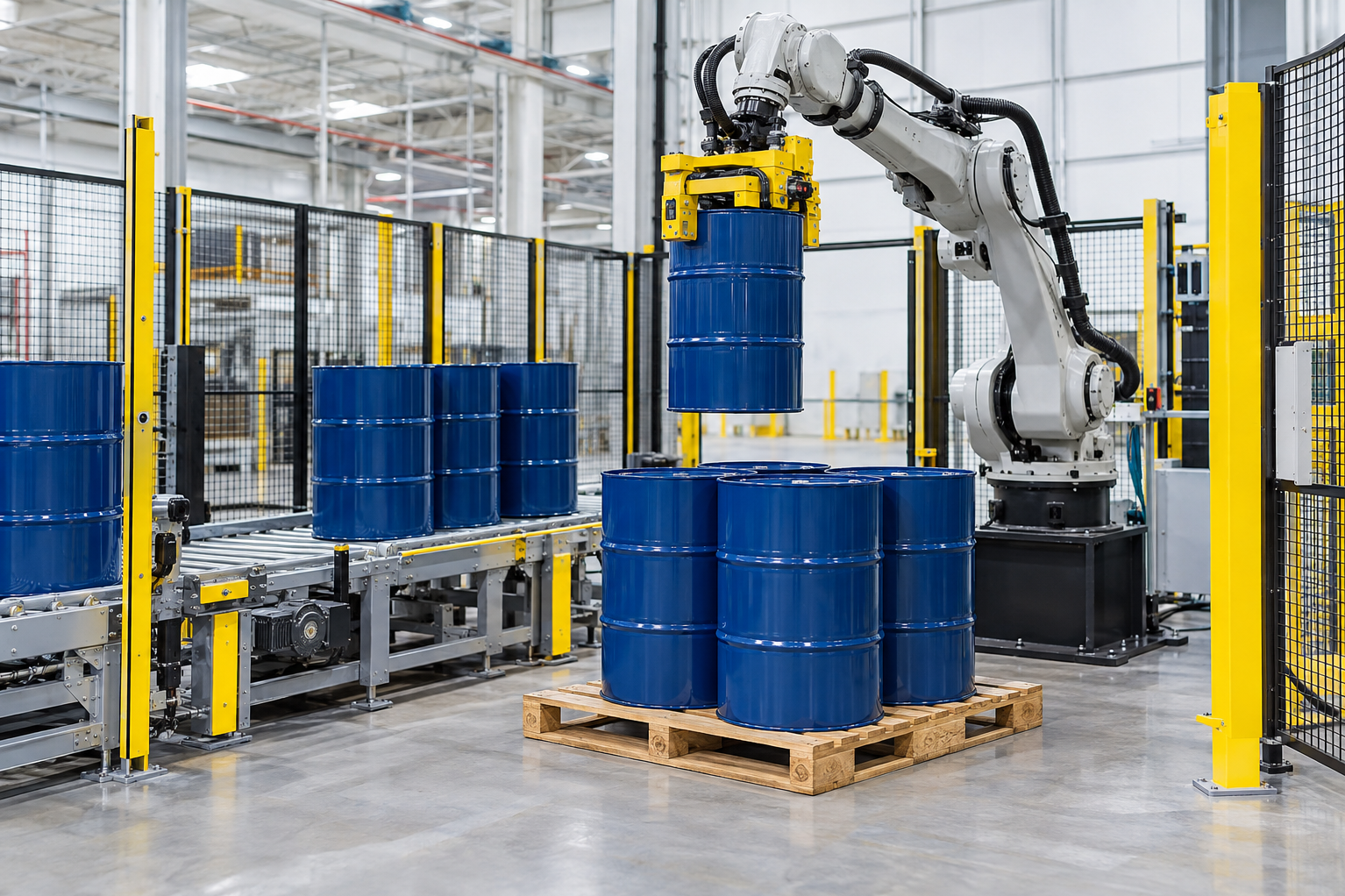
Industrial drums are difficult loads to handle manually because their shape, weight, and contents can make lifting and positioning challenging. Operations involving chemicals, lubricants, paints, oils, pharmaceuticals, food ingredients, and other bulk materials may regularly need to transfer drums between floors, pallets, storage areas, and processing locations.
Working with a suitable Drum Palletizer Manufacturer can help businesses evaluate equipment specifically designed around these handling movements.
Where Drum Handling Becomes Difficult
Problems often appear at the point where a drum needs to be lifted onto or removed from a pallet.
A conventional pallet truck may transport a pallet, but it does not necessarily solve the task of individually positioning drums. Manual handling can also become impractical as drum weight increases.
Typical requirements include:
- Lifting drums from floor level
- Placing drums onto pallets
- Removing drums from pallets
- Repositioning drums within production areas
- Supporting loading or unloading operations
- Moving drums between storage and processing locations
The equipment configuration should reflect the exact movement required.
Drum Type Matters
Not every industrial drum has identical dimensions or construction.
Before equipment is selected, buyers should identify drum diameter, height, weight, material, rim or gripping characteristics, and whether multiple drum types will be handled.
If a facility regularly receives drums from several suppliers, dimensional variations should be discussed during specification.
This is particularly important because a handling mechanism that works effectively with one container configuration may not automatically suit another.
Understand the Entire Movement
Instead of describing the requirement as 'we need to lift a drum,' map the complete task.
Where does the drum start? How is it approached? How high must it be lifted? Where is it placed? Is the destination a pallet, weighing station, machine, platform, or storage area?
Also consider how much maneuvering space is available.
These details help determine whether the proposed equipment will work within real operating conditions.
Compare Manual Handling With Mechanized Handling
The value of drum-handling equipment is usually found in repetitive operations.
If employees regularly need to position heavy drums, mechanized handling can make the process more controlled and reduce dependence on strenuous manual movement.
However, buyers should not assume that any drum palletizer will automatically improve productivity. The equipment must fit the drum, floor, aisle, pallet configuration, and workflow.
A unit that is difficult to maneuver could simply shift the bottleneck elsewhere.
Questions Procurement Teams Should Ask
When evaluating equipment, discuss:
- Which drum sizes can be handled?
- What is the rated capacity?
- How does the gripping or holding mechanism work?
- What lifting height is available?
- What aisle width is required?
- Can the unit work with existing pallets?
- What floor conditions are suitable?
- What inspection and maintenance are required?
A supplier should be able to connect these technical points with the intended application.
Evaluate the Site Before Ordering
Factories around Pune and Maharashtra can have very different production layouts. Some have broad material movement areas, while others operate within older buildings containing narrow passages and tightly positioned machines.
VIMALNX EQUIPMENTS PVT LTD can assess material handling requirements in this industrial context, but buyers can make the discussion more productive by providing actual site measurements and drum specifications.
Photographs, drawings, pallet dimensions, and descriptions of the current process can also help clarify requirements.
Look for Process Improvement, Not Just Equipment
Purchasing a drum palletizer should solve a specific handling problem.
The best results usually come when procurement teams evaluate the equipment as part of the complete material flow. Consider how drums are received, stored, transferred, opened or processed, and eventually dispatched or disposed of.
When the selected equipment fits naturally into that sequence, drum movement can become more organized and predictable.
For industrial facilities dealing with repetitive drum handling, the decision should ultimately be based on compatibility with actual containers, available space, lifting requirements, and daily operating conditions rather than capacity alone.