

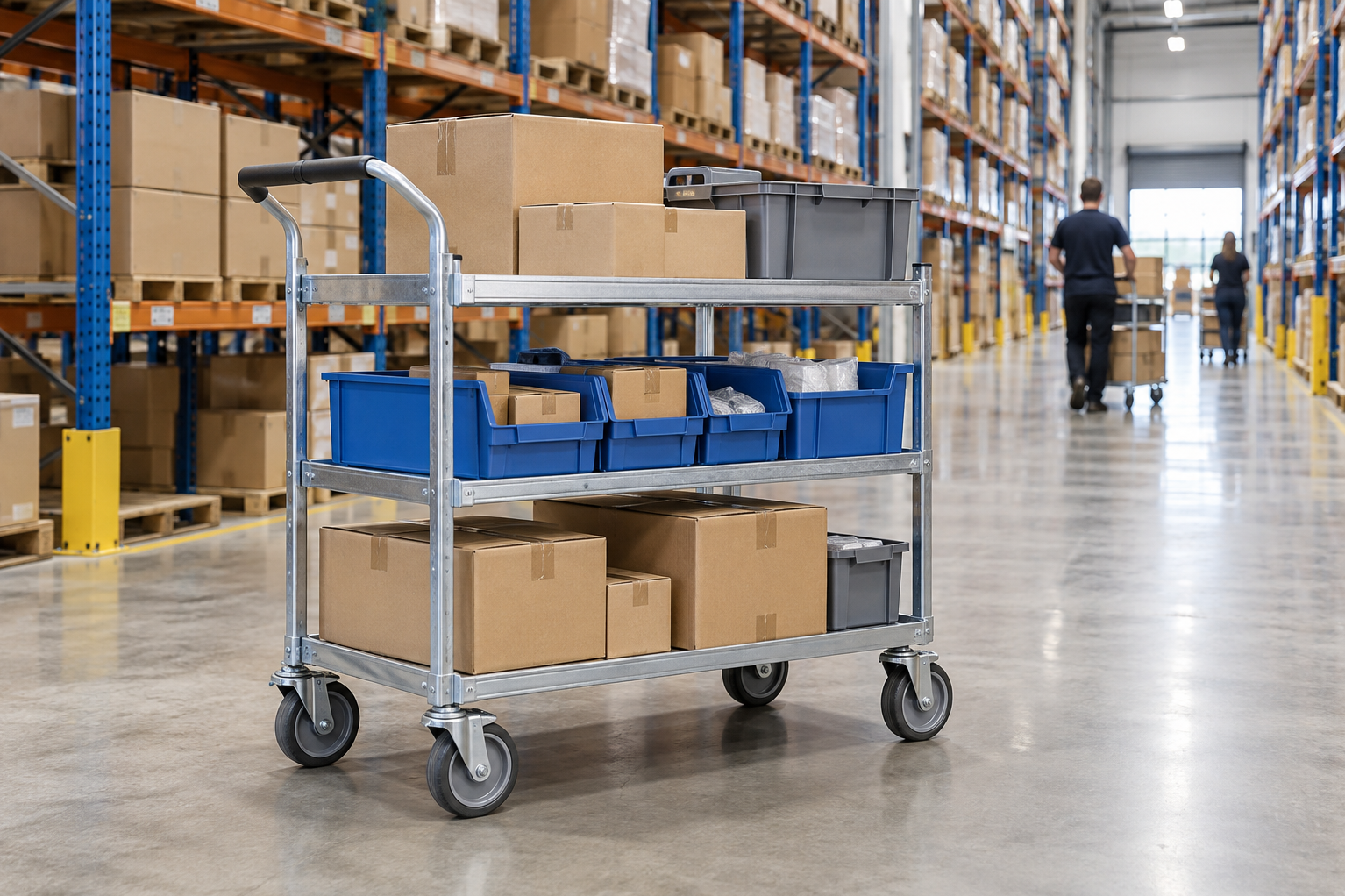
Order picking can account for a substantial amount of movement inside a warehouse. Employees may repeatedly walk between storage locations, collect several SKUs, transport them to packing stations, and return for another picking cycle.
Choosing the right Order Picking Trolley Supplier can help warehouse teams address these movements with equipment suited to their products and picking methods.
Start by Studying the Picking Process
Before comparing trolley designs, observe a typical order from release to packing.
How many items are normally collected per trip? Are products small cartons, components, tools, bins, or mixed items? How far does an operator travel? Are several customer orders picked simultaneously?
These questions reveal what the trolley actually needs to accomplish.
A generic platform trolley may move products, but an order-picking trolley should support the workflow surrounding the picking operation.
Capacity Should Include Volume and Weight
Maximum load capacity is important, but weight alone can be misleading.
Lightweight products may occupy substantial space, while small industrial components can create high concentrated loads.
Procurement managers should therefore consider both the total weight and physical volume of a normal picking batch.
Shelf spacing, platform dimensions, number of levels, and overall trolley size can then be matched more effectively to the inventory.
Maneuverability Influences Picking Speed
An oversized trolley may reduce the number of trips but become difficult to maneuver through warehouse aisles.
A smaller trolley may be easier to control but require frequent returns to the packing area.
The objective is to find a practical balance.
Measure aisle widths, intersections, doorways, picking zones, and congested areas before specifying equipment. Wheel configuration and trolley dimensions should suit the actual warehouse floor.
Consider Multi-Order Picking
Some operations increase picking efficiency by collecting products for multiple orders during one warehouse trip.
In this situation, compartmentalized shelves, bins, or clearly separated picking positions can help operators keep orders organized.
The trolley design should complement the warehouse's picking logic rather than create an additional sorting task later.
For businesses using barcode scanning or digital picking systems, equipment layout should also allow operators to handle devices comfortably.
Evaluate Ergonomics and Daily Usability
A trolley may be technically capable of carrying the required load yet inconvenient for employees using it throughout a shift.
Consider handle position, working height, visibility, wheel movement, braking arrangements where applicable, and ease of loading or unloading.
Frequently accessed items should be positioned so that normal picking does not involve unnecessary bending or awkward movement.
These details become increasingly important in high-frequency operations.
Standard or Application-Specific Design?
Standard trolleys may be suitable for straightforward picking requirements.
More specialized operations may benefit from configurations developed around particular bins, containers, component dimensions, or picking sequences.
VIMALNX EQUIPMENTS PVT LTD operates within the material handling equipment sector in Pune and can be considered where industrial buyers need to evaluate how trolley dimensions and configurations relate to warehouse processes.
The important point is to customize only where customization solves a real operational problem.
A Practical Buying Checklist
Before requesting quotations, document:
- Typical and maximum load
- Product dimensions
- Number of orders per picking trip
- Aisle dimensions
- Required shelves or compartments
- Floor conditions
- Travel distance
- Daily usage frequency
- Packing or dispatch interface
- Storage requirements for empty trolleys
This information allows suppliers to propose equipment against a defined requirement.
Think in Terms of Cost per Pick
Purchase price should not be the only commercial consideration.
A trolley that improves organization, reduces unnecessary walking, supports larger picking batches, or integrates better with the packing process may provide operational value over repeated daily cycles.
Warehouses in Pune, Maharashtra, serving manufacturing and distribution operations can therefore evaluate picking equipment based on workflow improvement rather than simply comparing trolley prices.
A well-matched order picking trolley should make the operator's route easier, keep picked materials organized, and fit naturally into the journey from storage location to packing or production.