

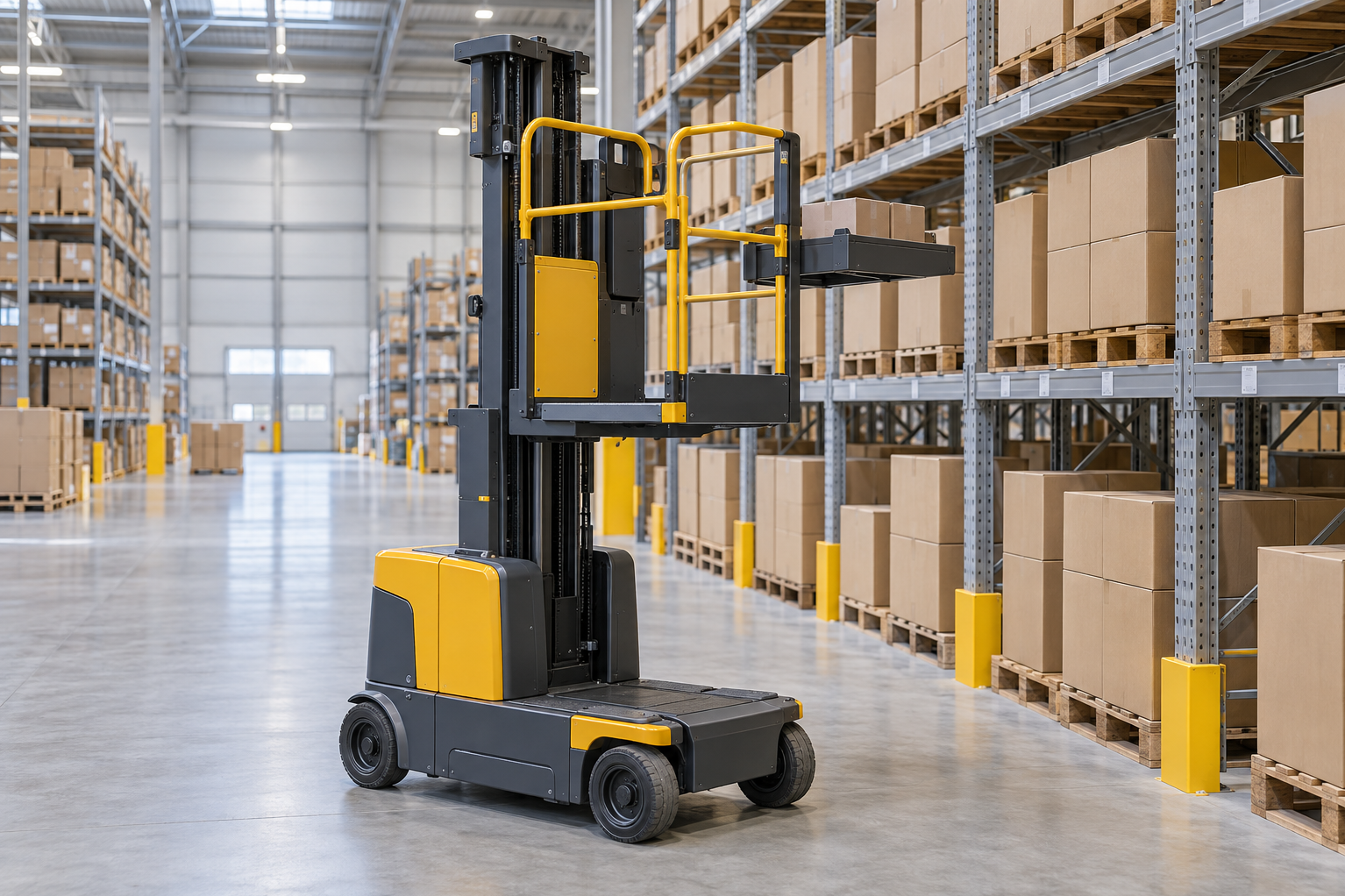
As warehouses use greater vertical height, picking items stored above comfortable ground-level reach becomes a practical operational challenge. The solution is not simply to provide access to higher shelves; workers also need a controlled way to reach picking locations and handle goods within the intended operating environment.
A Mobile Order Picker Manufacturer should therefore understand rack height, product characteristics, aisle dimensions, picking frequency, and warehouse floor conditions before recommending equipment.
When Does a Mobile Order Picker Make Sense?
Mobile order picking equipment can be relevant where individual items, cartons, or components need to be retrieved from elevated storage positions.
This differs from full-pallet handling. The operator may need direct access to a particular shelf or picking location rather than moving an entire pallet.
Typical environments can include:
- Spare-parts warehouses
- Industrial stores
- Distribution facilities
- Component storage areas
- Maintenance stores
- Manufacturing warehouses
The exact equipment requirements depend on working height and operating conditions.
Picking Height Should Be Measured Correctly
Warehouse teams sometimes specify rack height rather than the actual height at which an operator needs to work.
These figures are not always the same.
Determine the highest picking location and understand where the operator needs to stand relative to that location. Product size and handling method also matter because retrieving a small box is different from handling a bulky component.
Accurate measurements make equipment comparisons more meaningful.
Aisle Dimensions Can Limit Equipment Choice
An order picker must reach the storage location, but it must first move through the warehouse.
Measure clear aisle widths rather than relying only on layout drawings. Pallets protruding from racks, column guards, temporary inventory, structural elements, and other equipment can reduce usable space.
Turning areas at aisle ends should also be evaluated.
Warehouses in established industrial zones around Pune may have layouts that were not originally designed for mobile elevated picking, making site assessment particularly useful.
Floor Conditions Matter
Mobile equipment performs best when the operating surface is appropriate for its design.
Uneven floors, slopes, damaged surfaces, thresholds, or transitions between operational areas should be identified before equipment selection.
Procurement teams should explain these conditions to the manufacturer instead of assuming all internal warehouse floors are equivalent.
Do Not Ignore Picking Frequency
Occasional access to slow-moving inventory creates a different requirement from continuous order fulfillment.
If employees perform elevated picks repeatedly throughout a shift, maneuverability, controls, operating efficiency, charging requirements where relevant, and overall usability become more significant.
Understanding cycle frequency also helps determine whether the equipment addresses a genuine operational bottleneck.
Compare Equipment Against the Workflow
VIMALNX EQUIPMENTS PVT LTD serves material handling requirements in Pune, Maharashtra, where warehouses range from manufacturing stores to larger logistics operations.
When evaluating mobile order picking equipment, buyers should examine the complete process:
- Travel from the staging point
- Entry into the picking aisle
- Positioning at the rack
- Access to the required level
- Retrieval of the item
- Storage of the picked item
- Movement to the next location
- Return to packing or production
Small inefficiencies at each stage can become significant across hundreds of daily picks.
Readiness Signs Before Investing
A warehouse may be ready to evaluate a mobile order picker when elevated inventory is increasing, employees frequently need access to upper levels, existing picking methods create delays, or additional vertical storage is being planned.
The equipment should be selected alongside the racking and picking strategy rather than after those decisions are complete.
For growing warehouses in Pune, effective vertical utilization depends on both storage infrastructure and practical access. When working height, aisle dimensions, inventory characteristics, floor conditions, and picking frequency are considered together, mobile order picking can become a much more integrated part of warehouse operations.