

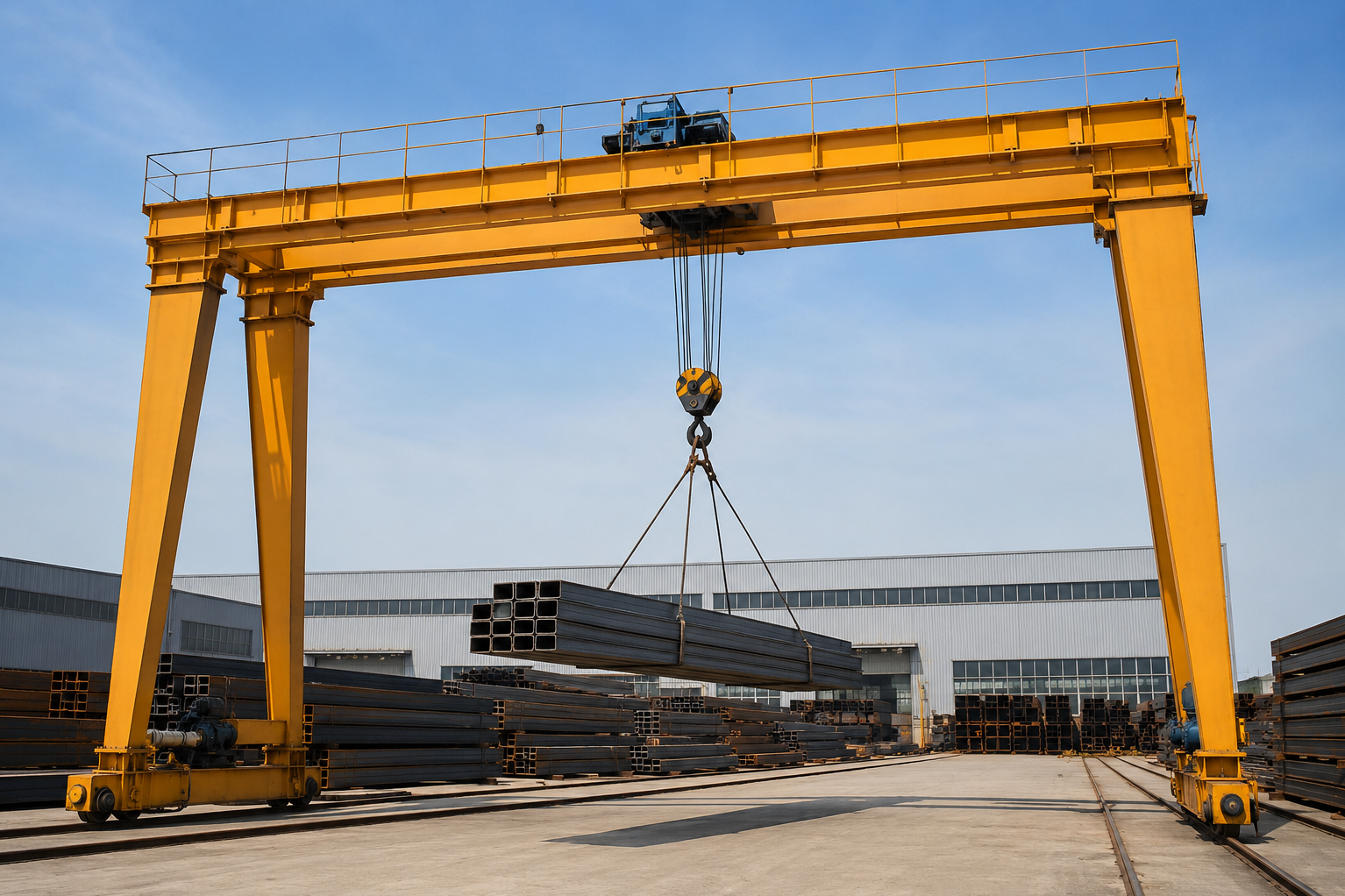
Industrial facilities do not always have the building structure, operational need, or budget justification for permanent overhead lifting systems. In such situations, a gantry crane can provide a more flexible approach to handling heavy components within defined work areas.
When evaluating a Gantry Crane Supplier, procurement teams should look beyond lifting capacity and consider span, height, movement, structural configuration, operating environment, and the actual handling process.
Where Gantry Cranes Are Commonly Used
Gantry cranes use a supporting frame that allows lifting equipment to operate above the load. Depending on their design, they can support applications in manufacturing, maintenance, fabrication, warehouses, assembly facilities, and loading areas.
Typical uses may include:
- Handling fabricated components
- Lifting machinery during maintenance
- Moving assemblies between work areas
- Loading or positioning industrial equipment
- Supporting repair operations
- Handling materials where permanent crane structures are unavailable
The crane configuration should always be selected according to the intended application.
Start With the Required Working Area
One of the first questions is how much space the crane needs to cover.
Measure the clear span required between supporting legs and determine the maximum lifting height needed. Buyers should also check whether pipes, lighting, cable trays, machines, doors, or structural elements could interfere with crane movement.
For existing factories in Pune, this assessment is particularly important because production layouts may already contain multiple utilities and fixed machines.
Understand the Load Properly
Knowing that a component weighs two or three tonnes, for example, does not provide enough information for equipment selection.
A supplier may also need to understand:
- Maximum and routine load weights
- Physical dimensions of the load
- Centre-of-gravity considerations
- Lifting points
- Frequency of operation
- Required travel distance
- Indoor or outdoor usage
- Available floor conditions
Providing accurate information at the beginning can reduce specification changes later.
Fixed and Mobile Requirements Differ
Some operations need lifting within one defined area. Others need equipment that can be repositioned.
A mobile gantry configuration may offer flexibility where several workstations occasionally require lifting assistance. However, mobility introduces additional considerations involving wheel design, floor quality, maneuvering space, and operating procedures.
A fixed configuration may be more appropriate when the handling process remains concentrated in one area.
The choice should therefore follow workflow requirements rather than simply selecting whichever configuration appears more versatile.
Look at Construction and Maintainability
Industrial lifting equipment works in demanding environments, so buyers should examine how the crane has been engineered and fabricated.
Discuss structural design, material selection, fabrication quality, lifting mechanism compatibility, maintenance access, and components that may require periodic inspection or replacement.
Documentation should also be reviewed as part of procurement.
Supplier Evaluation Should Be Application-Based
A capable supplier should ask detailed questions before recommending a configuration.
If a supplier provides an equipment recommendation without understanding span, height, capacity, usage frequency, or site conditions, the procurement team may need to investigate further.
Industrial buyers can make the evaluation more effective by preparing a basic requirement sheet containing:
- Required capacity
- Clear span
- Required lifting height
- Overall space restrictions
- Indoor or outdoor environment
- Frequency of operation
- Movement requirements
- Load details
This creates a common basis for comparing technical proposals.
Consider the Local Industrial Context
Pune and Maharashtra contain a broad mix of automotive, engineering, fabrication, warehousing, processing, and manufacturing facilities. Their material handling requirements can vary considerably even when the nominal lifting capacity is similar.
A fabrication facility handling large structures may prioritize span and accessibility, while a maintenance department may place greater importance on mobility and occasional-use flexibility.
Selecting a gantry crane should therefore begin with the process rather than the product catalogue.
When specifications are based on actual loads, available space, workflow, and operating frequency, procurement teams can identify equipment that integrates more effectively with everyday industrial operations.