

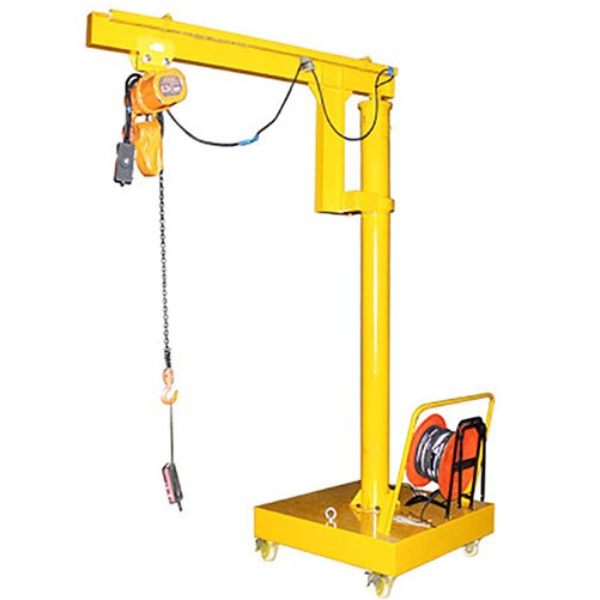
Moving heavy components across a factory floor can become difficult when overhead lifting systems are unavailable or when materials need to be handled at different workstations. A well-designed floor crane provides a practical alternative for lifting, positioning, loading, and transferring industrial components within a controlled working area.
For manufacturing companies in Pune and other industrial regions of Maharashtra, selecting the right Floor Crane Manufacturer starts with understanding the load, operating environment, lifting height, floor conditions, and frequency of use.
What Is a Floor Crane?
A floor crane is a mobile lifting device designed to lift and reposition heavy loads at ground level. Unlike permanently installed overhead cranes, floor cranes can often be moved between workstations as operational requirements change.
They are commonly considered for applications such as:
- Loading and unloading machine components
- Positioning dies, motors, pumps, and assemblies
- Handling maintenance components
- Supporting fabrication and engineering operations
- Moving loads between workstations
- Assisting with equipment installation or servicing
The actual suitability depends on crane capacity, boom configuration, mobility, available clearance, and the characteristics of the load.
Why Load Assessment Comes First
Rated lifting capacity should never be the only factor considered when evaluating a floor crane.
The position of the load relative to the crane affects lifting performance. A load positioned farther along an extended boom can create different operating conditions compared with a load lifted closer to the crane body.
Industrial buyers should therefore provide the manufacturer with information about the actual application rather than simply requesting a crane based on maximum load weight.
Important details include the typical and maximum load, required lifting height, load dimensions, operating radius, available aisle space, floor surface, and expected usage frequency.
Mobility Can Improve Shop-Floor Flexibility
One advantage of floor cranes is their ability to support operations where permanent lifting infrastructure may not be practical.
Consider a factory where maintenance teams occasionally need to remove motors from different machines. Installing a dedicated crane above every machine could be inefficient. A suitable mobile floor crane may serve multiple work areas when the layout and operating conditions permit.
This flexibility can be particularly useful for engineering workshops, automotive facilities, fabrication plants, warehouses, maintenance departments, and equipment assembly operations.
Check the Available Working Space
A crane that meets the required lifting capacity may still be unsuitable if it cannot move comfortably through the facility.
Before finalizing specifications, measure:
- Aisle widths
- Door and entry clearances
- Space around machinery
- Turning areas
- Maximum available height
- Floor condition and level differences
- Storage space when the crane is not operating
Facilities in established industrial areas around Pune may have layouts that have evolved over several years. Equipment selection should therefore reflect actual shop-floor conditions rather than idealized dimensions.
Consider How Frequently the Crane Will Be Used
Occasional maintenance lifting and continuous production handling are very different applications.
A crane used periodically by a maintenance department may have different operational requirements from equipment expected to support repetitive handling throughout a production shift.
Usage frequency can influence decisions concerning operating mechanism, maneuverability, construction, maintenance accessibility, and overall equipment configuration.
Safety and Ease of Operation Matter
Material handling equipment should support predictable and controlled movement. Buyers should evaluate the stability of the equipment, operating controls, wheel arrangement, braking provisions where applicable, load-handling method, and maintenance requirements.
Operators should also receive appropriate instructions for the specific equipment being used.
A technically suitable crane combined with correct operating practices can make material movement more structured and reduce unnecessary manual handling.
Matching the Crane to the Application
The most useful approach is to discuss the complete lifting operation with the manufacturer. Share component drawings or dimensions where relevant, explain where the crane will operate, and identify any space limitations before specifications are finalized.
For industrial facilities across Pune, Maharashtra, floor cranes can provide valuable shop-floor flexibility when equipment capacity, reach, mobility, and operating conditions are properly matched.
The right selection is therefore not simply about finding equipment capable of lifting a stated weight. It is about creating a lifting solution that works safely and practically within the real production environment.